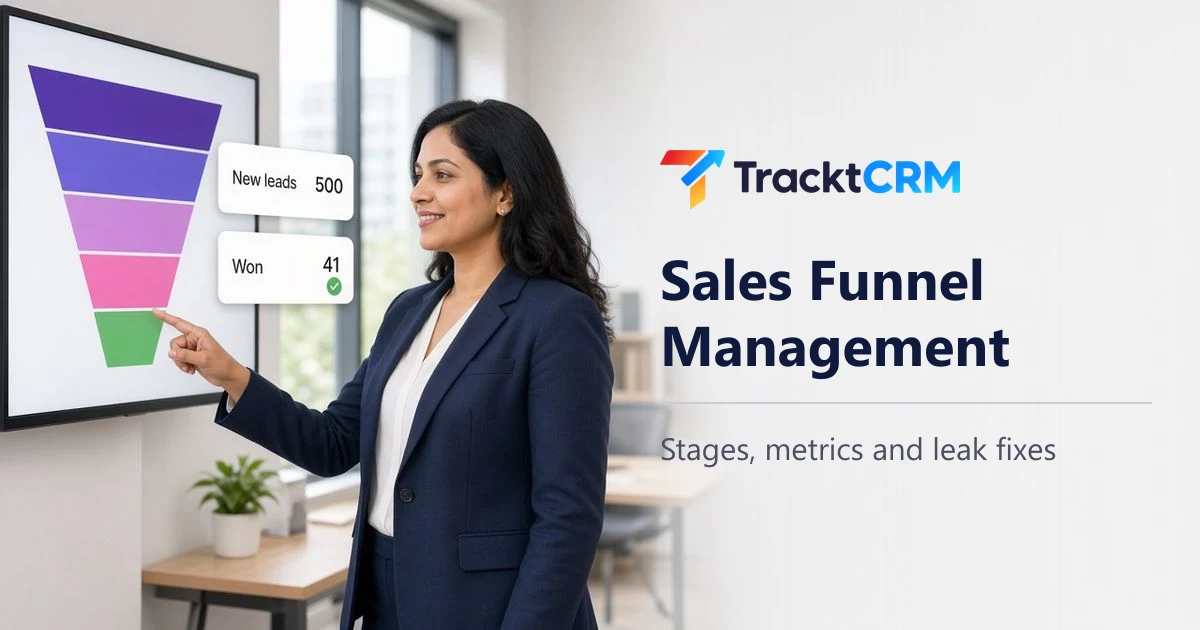
Sales funnel management is the process of defining the stages a lead passes through before it buys, measuring how many leads move from each stage to the next, and fixing the stages where too many drop out. Done well, it gets you more revenue from the leads you already pay for, before you spend another rupee on ads.
This guide explains the difference between a funnel and a pipeline, gives you stage definitions with clear entry and exit rules, walks through the funnel math with a worked example, and shows how to find and fix the leak that costs you the most.
What Is Sales Funnel Management?
Every business has a sales funnel, whether it is written down or not. Leads come in at the top, some get contacted, fewer turn out to be a good fit, fewer still get a quote, and a handful buy. The shape narrows at each step, which is why it is called a funnel.
Managing the funnel means making that narrowing visible and deliberate. Instead of asking "why are sales low this month?", you can say "we contacted only 70% of new leads, and only one in five quotes turned into an order". Those are problems you can fix.
Sales Funnel vs Sales Pipeline
The two terms are often used as if they mean the same thing. They are related, but they answer different questions.
| Sales funnel | Sales pipeline | |
|---|---|---|
| Question it answers | Where are we losing buyers? | What do we need to do next, on which deal? |
| What it shows | Number and percentage of leads at each stage | Individual deals, their value, owner and next step |
| Who uses it most | Owners, sales managers, marketing | Sales reps, every day |
| Time view | A period, such as this month or this quarter | Right now |
| Typical action | Fix a stage, change targeting, retrain the team | Call this lead, send that quote, chase this payment |
In practice you need both. The pipeline is where the work happens. The funnel is the scorecard that tells you which part of the work to improve.
The Stages of a Sales Funnel (With Entry and Exit Rules)
Stage names vary by industry, but most high-ticket and B2B funnels in India follow a pattern like the one below. The important part is the exit rule: a lead moves forward only when something you can verify has happened. Without exit rules, reps move deals forward on optimism and the funnel stops meaning anything.
| Stage | Enters when | Exits to the next stage when | Owner's job |
|---|---|---|---|
| New lead | An enquiry arrives from an ad, form, call, WhatsApp or portal | First two-way conversation happens | Reply within the hour |
| Contacted | You have spoken or chatted with the buyer | Need, budget range and timeline are confirmed | Qualify with a few simple questions |
| Qualified | The lead is a fit and has a real need | A meeting, demo or site visit is booked | Book the next step with a date |
| Meeting, demo or visit | The meeting or visit is scheduled | It happens and the buyer asks for pricing | Show the solution for their specific case |
| Proposal or quote | A quote or proposal is sent | The buyer gives feedback or starts negotiating | Follow up on the quote, handle objections |
| Negotiation | Terms, price or scope are being discussed | Order, payment or signed agreement | Agree final terms and close |
| Won or lost | Deal is closed | Record the lost reason, hand over won deals |
A simple qualification checklist for the "contacted" stage works well for most businesses: Is there a real need? Is the budget in range? Is there a timeline in the next three months? Are we talking to the person who decides, or can they bring that person in?
How to Build and Manage Your Sales Funnel in 7 Steps
- Map how your buyers actually buy. List the steps a typical customer took before they paid. Use your last 20 won deals, not what you wish happened.
- Turn those steps into five to seven stages. Fewer stages are easier to keep accurate. Write the exit rule for each one.
- Tag every lead with a source. Ads, website forms, IndiaMART, Justdial, property portals, referrals, walk-ins. Without a source you cannot tell which channel brings buyers and which brings browsers.
- Assign an owner and a response target. Every lead gets one owner the moment it arrives, with a target such as "first contact within 15 minutes".
- Set a follow-up rule for each stage. For example: call a quote two days after sending it. Our sales follow-up strategy has a full cadence.
- Make "lost" a stage with reasons. Price, timing, chose competitor, no response, not a fit. Pick from a fixed list so the numbers add up.
- Review weekly. Look at conversion rates, stuck deals and lost reasons, then change one thing at a time.
Sales Funnel Math: A Worked Example
Funnel numbers turn vague worries into clear priorities. Here is a month of data for a business with an average deal size of ₹60,000.
| Stage | Leads | Conversion to this stage |
|---|---|---|
| New leads | 500 | |
| Contacted | 400 | 80% |
| Qualified | 160 | 40% |
| Meeting or demo | 80 | 50% |
| Proposal sent | 56 | 70% |
| Won | 14 | 25% |
That is 14 deals and ₹8.4 lakh in revenue from 500 leads, an overall conversion rate of 2.8%.
Now look at what happens if you improve just one stage, with the same 500 leads and no extra ad spend:
- Contact 95% of leads instead of 80%. Every later stage grows with it: about 17 deals and roughly ₹10.2 lakh. That is about 21% more revenue, mostly from replying faster and calling back missed leads.
- Win 35% of proposals instead of 25%. About 20 deals and roughly ₹12 lakh, about 43% more revenue, from better quote follow-up and objection handling.
This is why funnel management usually beats buying more leads. If your funnel leaks at the contact stage, doubling your ad budget doubles the leads you never call.
Speed is worth checking first. In the Harvard Business Review study of 1.25 million leads, firms that contacted a lead within an hour were nearly seven times as likely to qualify it as firms that waited even one hour longer.
How to Find and Fix Leaks in Your Sales Funnel
Find the stage with the biggest drop compared with your normal rate, then check the lost reasons recorded there. This table covers the most common leaks.
| Symptom | Likely cause | Fix |
|---|---|---|
| Many leads never contacted | Slow response, no owner, leads stuck in email or a portal | Auto-assign leads, set a 15-minute response target, alert on untouched leads |
| Low contacted-to-qualified rate | Poor targeting or wrong lead sources | Compare quality by source, cut sources that bring browsers, tighten ad targeting |
| Qualified leads do not book meetings | No clear next step at the end of the call | End every call with a dated next step, send a calendar invite or visit confirmation |
| Meetings happen but no quote is requested | Generic demo, wrong decision maker | Prepare for the buyer's use case, ask who else needs to be involved |
| Quotes sent, few orders | Weak follow-up, price surprise, slow quotes | Follow up within two days, share price ranges earlier, send quotes same day |
| Deals sit in negotiation for weeks | No deadline, unclear approval process | Ask about the approval steps early, agree a decision date |
| Many deals lost to "no response" | Follow-up stops too early or is too pushy | Use a planned cadence across call, WhatsApp and email |
Sales Funnel Examples by Industry
Your stages should match how your buyers decide. Here is how the funnel looks in a few common Indian businesses.
| Industry | Typical stages | Where it usually leaks |
|---|---|---|
| Real estate | Enquiry, contacted, site visit scheduled, site visit done, negotiation, booking | Between enquiry and site visit, when portal leads are not called fast |
| Education and coaching | Enquiry, counselling call, campus visit or demo class, application, fee paid | After the counselling call, when parents compare institutes |
| B2B services and agencies | Lead, discovery call, proposal, negotiation, signed | Proposal to signed, when follow-up depends on one person |
| Clinics and hospitals | Enquiry, appointment booked, visited, treatment plan, follow-up visit | Appointment no-shows and missed review visits |
| Manufacturing and wholesale | Enquiry, requirement confirmed, sample or quote, negotiation, purchase order | Quote to purchase order, when price comparisons drag on |
6 Sales Funnel Metrics to Review Every Week
| Metric | How to calculate | Why it matters |
|---|---|---|
| Lead-to-contact rate | Leads contacted ÷ new leads × 100 | Shows whether speed and ownership are working |
| Stage conversion rate | Leads reaching the next stage ÷ leads in this stage × 100 | Pinpoints the leak |
| Win rate | Deals won ÷ (deals won + deals lost) × 100 | Shows how well you close qualified opportunities |
| Average deal size | Revenue won ÷ deals won | Helps forecast and compare reps fairly |
| Sales cycle length | Average days from new lead to won | Longer cycles need more follow-up touches |
| Lost reasons | Count of lost deals by reason | Tells you whether to fix speed, price, follow-up or targeting |
Keep the review short. Compare this week with the last four weeks, pick the single biggest drop, agree one change and check it again next week.
Managing a Sales Funnel in Excel vs a CRM
Excel is a fine place to start. If you use a spreadsheet, keep these columns: lead name, phone, source, owner, stage, deal value, date created, last contact date, next follow-up date and lost reason. Use a fixed dropdown for stage and lost reason so you can count them.
A spreadsheet starts to hurt when:
- More than one person updates it and versions clash.
- Follow-up dates are in the sheet but nobody gets reminded.
- WhatsApp chats and calls live on personal phones, not with the lead.
- You spend Monday mornings building the funnel report by hand.
At that point a CRM saves more time than it costs. Our CRM vs Excel comparison goes through the trade-offs in detail.
How to Manage Your Sales Funnel in TracktCRM
TracktCRM keeps the funnel and the pipeline in the same place, so the numbers update as your team works.
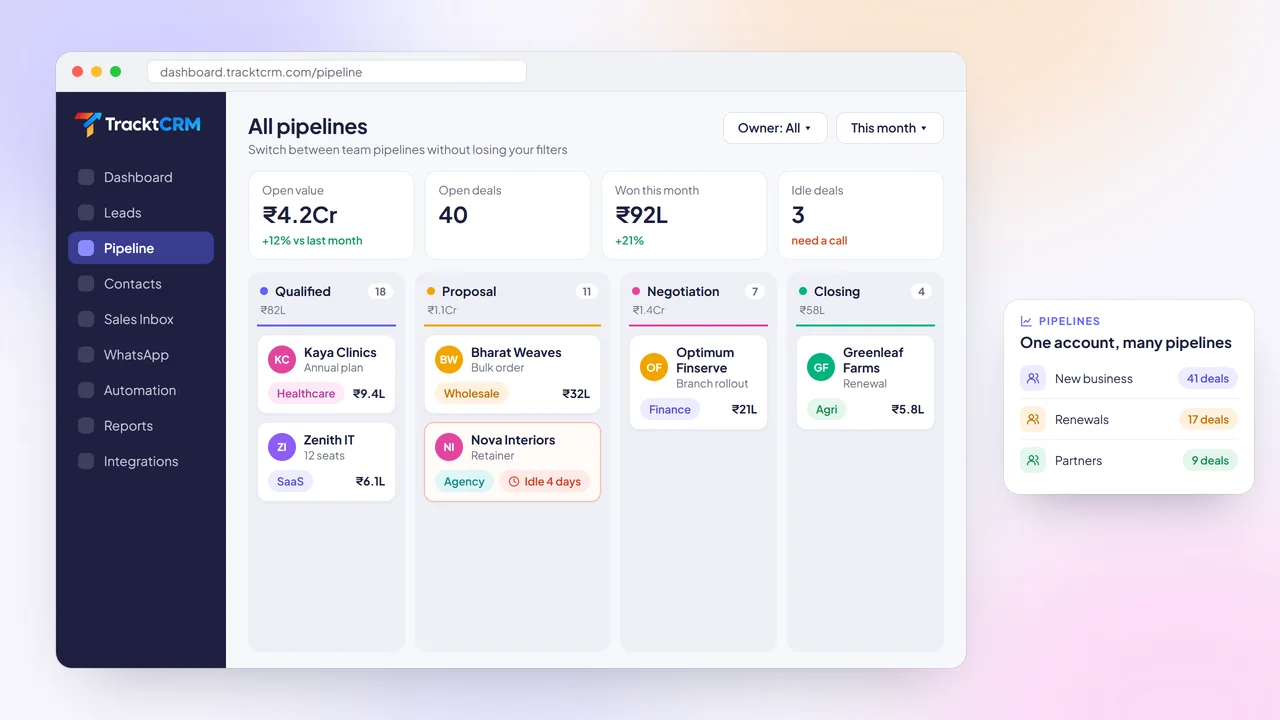
- Pipelines and stages that match your process. Create separate pipelines for new business, renewals or different products, each with its own stages and a win probability per stage.
- Stage count and value at a glance. The board shows how many deals sit in each stage and what they are worth, so you can see the shape of the funnel every morning.
- Idle deal alerts. Set how many days a deal can stay in a stage before it is flagged as rotting, so stuck deals get attention.
- Lost reasons. Mark a deal as lost with a reason, then see the reasons on your dashboard.
- Reports by pipeline, stage, owner and period. See total, won, lost and open deals for any filter. The dashboard adds revenue won by each rep and a comparison with the previous period.
- Leads from every source. Bring in leads from Meta and Google ads, website forms, WhatsApp, IndiaMART, Justdial and property portals, with the source saved on each one.
- Automation at stage changes. When a deal moves to a new stage, create a follow-up task, notify the owner or, on Pro and above with the official WhatsApp Business API, send an approved WhatsApp template.
See reporting and analytics for the reports, or sales automation for follow-up reminders at each stage.
Common Sales Funnel Management Mistakes
- Too many stages. Ten stages that nobody updates are worse than five that are always accurate.
- No exit rules. If "proposal" means different things to different reps, the funnel numbers mean nothing.
- Tracking only the top and the bottom. Leads in and sales out hide where the problem is.
- Deleting lost deals. Lost deals with reasons are the most useful data in your CRM.
- Buying more leads to fix a conversion problem. Fix the leak first, then scale the spend.
- Reviewing once a quarter. By then the leads you lost are months old.
Frequently Asked Questions
What is sales funnel management?
Sales funnel management is the process of defining the stages a lead goes through before buying, tracking how many leads move from each stage to the next, and fixing the stages where too many drop out. The goal is more revenue from the leads you already get.
What is the difference between a sales funnel and a sales pipeline?
A sales funnel shows conversion: how many leads move through each stage and where they drop out. A sales pipeline shows the individual deals in each stage, their value and the next action. Managers use the funnel to spot leaks and the pipeline to manage day-to-day selling.
What are the stages of a sales funnel?
A typical B2B or high-ticket funnel has six stages: new lead, contacted, qualified, meeting or demo, proposal and won or lost. Stage names vary by industry. A real estate funnel might use enquiry, site visit, negotiation and booking instead.
How do you calculate sales funnel conversion rate?
Divide the number of leads that reached the next stage by the number that entered the current stage, then multiply by 100. If 160 leads were qualified and 80 of them booked a meeting, the qualified-to-meeting conversion rate is 50%.
How do I find leaks in my sales funnel?
Compare stage-to-stage conversion rates over the same period and look for the biggest drop. Then check the lost reasons recorded at that stage. A low contact rate usually points to slow response, while a low proposal-to-won rate often points to weak follow-up or pricing.
How often should I review my sales funnel?
Review the pipeline daily for next actions, and the funnel weekly for conversion rates and stuck deals. Do a monthly review of lost reasons, lead sources and stage definitions to decide what to change.
Can I manage a sales funnel in Excel?
You can start in Excel with columns for stage, owner, value, source, next follow-up and lost reason. Once you have more than one salesperson or more than a few dozen open deals, a CRM is easier because it updates stages, reminds owners and keeps history automatically.
Sources
Sources checked on . Plans and prices change, so confirm current details on these links before you buy.