Most lists of "CRM examples" give you 15 brand names and a logo. That does not help you decide anything. A CRM only makes sense when you can see what it does in a business like yours.
So this guide to CRM software examples does it differently. First, 15 real business examples: the problem, what the CRM does, and the pipeline stages that business uses. Then a short list of popular CRM software and who each one suits.
What is a CRM? (Quick answer)
A CRM (customer relationship management) system is software that keeps every lead and customer in one place, with their full history of calls, messages, quotes and follow-ups. It tells your team who to contact next and shows the owner where every deal stands.
The three main types of CRM are:
- Operational CRM: runs daily sales work: lead capture, assignment, follow-ups, pipelines. Most small business CRMs are this type.
- Analytical CRM: turns customer data into reports, such as which lead source converts best.
- Collaborative CRM: shares customer information across sales, support and other teams.
Modern CRMs, including TracktCRM, combine all three in one tool.
15 CRM software examples by business type
Each of these CRM software examples follows the same format: the problem the business had, what the CRM does about it and the pipeline stages it uses.
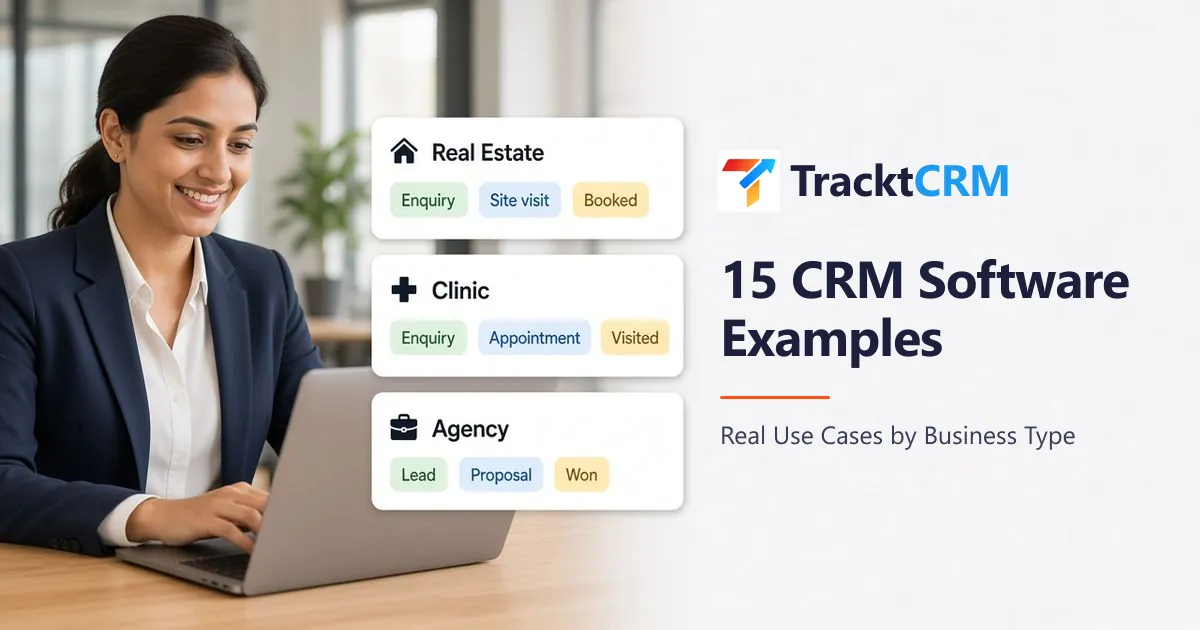
1. Real estate broker
Problem: enquiries arrive from 99acres, MagicBricks, Housing.com, Facebook ads and WhatsApp. Agents reply late and forget to call back after site visits.
What the CRM does: captures every portal lead automatically, assigns it to an agent by project or location, and reminds them before and after each site visit.
Pipeline stages: New enquiry → Contacted → Site visit scheduled → Site visit done → Negotiation → Booked / Lost.
Read more: real estate CRM.
2. Real estate builder with channel partners
Problem: the same buyer is brought by two brokers, and nobody can prove who sourced the lead first.
What the CRM does: records which channel partner added each lead and when, so commission disputes are settled from data, not arguments.
Pipeline stages: Lead registered by partner → Verified → Site visit → Booking → Agreement.
3. Car or two-wheeler dealership
Problem: walk-ins and test-drive requests are written in a register; most never get a second call.
What the CRM does: logs every walk-in and online enquiry, books test drives, and reminds sales staff to follow up until purchase.
Pipeline stages: Enquiry → Test drive → Quotation → Finance / exchange → Booked → Delivered.
Read more: automotive CRM.
4. Coaching institute or college admissions
Problem: hundreds of enquiries in admission season, counsellors in different branches, and parents asking the same questions again.
What the CRM does: routes each enquiry to a counsellor, schedules demo classes and campus visits, and keeps the full conversation history with the student and parent.
Pipeline stages: Enquiry → Counselling call → Demo class / visit → Application → Fee paid → Enrolled.
Read more: education CRM.
5. Clinic or hospital
Problem: patients enquire on the website, Practo, Google and WhatsApp, and the front desk misses calls during busy hours.
What the CRM does: brings every patient enquiry into one list, assigns it to staff, and sends appointment and follow-up reminders.
Pipeline stages: Enquiry → Called back → Appointment booked → Visited → Follow-up due.
Read more: healthcare CRM.
6. Diagnostic centre or lab
Problem: home-collection requests come in by phone and chat with no tracking of who confirmed the slot.
What the CRM does: turns each request into a lead with a time slot, an assigned person and a status.
Pipeline stages: Request → Slot confirmed → Sample collected → Report shared.
7. Insurance agent or POSP
Problem: renewal dates live in a diary, and missed renewals mean lost income every year.
What the CRM does: stores every policy with its due date and reminds the agent before each renewal; quote follow-ups run until the client decides.
Pipeline stages: Lead → Needs discussed → Quote sent → Policy issued → Renewal due.
Read more: insurance CRM.
8. Loan agent or DSA
Problem: each loan file waits on documents from the customer and approvals from the bank, and status updates live in WhatsApp.
What the CRM does: tracks each file stage by stage with document checklists and reminders, so no file sits idle.
Pipeline stages: Lead → Eligibility checked → Documents collected → Logged in with bank → Sanctioned → Disbursed.
9. Travel agency
Problem: holiday season enquiries pile up faster than the team can send itineraries.
What the CRM does: captures enquiries from ads, the website and WhatsApp, assigns them to an agent, and follows up until the trip is booked.
Pipeline stages: Enquiry → Itinerary sent → Revised quote → Booked → Travelled.
Read more: travel CRM.
10. Digital marketing agency
Problem: proposals, retainers and referrals are scattered across email, WhatsApp groups and spreadsheets.
What the CRM does: tracks every pitch from first call to signed retainer, with reminders for proposal follow-ups and renewals.
Pipeline stages: Lead → Discovery call → Proposal sent → Negotiation → Won → Retainer renewal.
Read more: CRM for agencies.
11. Recruitment firm
Problem: two pipelines at once, clients with open roles and candidates for those roles, and both go cold quickly.
What the CRM does: keeps client mandates and candidates in separate pipelines with follow-up reminders on both sides.
Pipeline stages (candidates): Sourced → Screened → Shared with client → Interview → Offer → Joined.
Read more: recruitment CRM.
12. B2B manufacturer or trader
Problem: IndiaMART, TradeIndia and Justdial leads arrive all day, and most are never answered.
What the CRM does: pulls these leads in automatically, assigns them by product or region, and tracks quotes and samples until the order.
Pipeline stages: Enquiry → Requirement confirmed → Quotation → Sample → Order → Repeat order.
13. Freelancer or consultant
Problem: a handful of high-value enquiries, but forgetting one follow-up costs a full month's income.
What the CRM does: a simple pipeline with reminders, so every enquiry gets a quote and every quote gets a follow-up.
Pipeline stages: Enquiry → Call → Proposal → Won → Repeat work.
14. Online store or D2C brand
Problem: customers ask questions on WhatsApp and Instagram before buying, and bulk or reseller enquiries get lost among them.
What the CRM does: separates high-value enquiries such as bulk orders into a pipeline and keeps chat history on each contact.
Pipeline stages: Enquiry → Quote → Payment link sent → Paid → Repeat customer.
15. Coworking space or service business
Problem: visit requests and membership enquiries are handled by whoever picks up the phone.
What the CRM does: books tours, tracks each enquiry to signed agreement and reminds staff about renewals.
Pipeline stages: Enquiry → Tour booked → Proposal → Agreement signed → Renewal due.
Popular CRM software examples
Here are well-known CRM software examples by brand, and who each one usually suits. Check each vendor's website for current features and prices.
| CRM software | Known for | Usually suits |
|---|---|---|
| Salesforce | Deep customisation and a huge app ecosystem | Large companies with admins and budget |
| HubSpot CRM | Marketing, sales and service in one suite | Inbound marketing teams |
| Zoho CRM | Wide feature set within the Zoho app family | Businesses already using Zoho |
| Bigin by Zoho | Simple pipeline CRM from Zoho | Very small teams |
| Pipedrive | Visual deal pipeline | Sales-led B2B teams |
| Freshsales | Built-in phone and email | Inside sales teams |
| Microsoft Dynamics 365 | Integration with Microsoft tools | Enterprises on Microsoft |
| LeadSquared | High-volume lead management | Large education, lending and healthcare teams |
| TracktCRM | Lead capture from portals, ads and WhatsApp, simple pipeline, free plan | Small and growing teams in real estate, education, healthcare, insurance, agencies |
Comparing options? See how TracktCRM stacks up against Pipedrive, HubSpot, Zoho CRM, Bigin, LeadSquared and TeleCRM. For a full Indian market list, read best CRM software in India. To see how a CRM handles all of the examples above in one tool, visit our CRM software page.
How to use these CRM software examples to pick a CRM
- Find your business in the examples above and write down your pipeline stages.
- List your lead sources. The CRM must capture them automatically, or your team will not use it.
- Check mobile use. If your team sells in the field, test the CRM on a phone first.
- Start free. Use a free plan with real leads for two weeks before paying.
- Count total cost per user, including any paid add-ons for WhatsApp or integrations.
Is a spreadsheet still enough for you? Read CRM vs Excel. Want to test before you pay? Read our guide to free CRM for small business.
Frequently Asked Questions
What is an example of a CRM?
A real estate broker who captures portal leads automatically, assigns them to agents and gets site-visit reminders is using a CRM. Popular CRM software examples include Salesforce, HubSpot, Zoho CRM, Pipedrive and TracktCRM.
Is Excel a CRM?
No. Excel can store a list of contacts, but it cannot capture leads automatically, remind your team to follow up or show live pipeline status. See our CRM vs Excel comparison.
Is WhatsApp a CRM?
No. WhatsApp is a messaging channel. A CRM with WhatsApp integration saves those chats on each lead, so the whole team sees the history.
What are the 3 types of CRM?
Operational, analytical and collaborative. Most small business CRMs combine all three.
Which CRM is best for a small business?
One that captures leads from your existing sources, works on mobile, is easy to set up in a day and has a free plan to test. Read our guide to free CRM for small business.