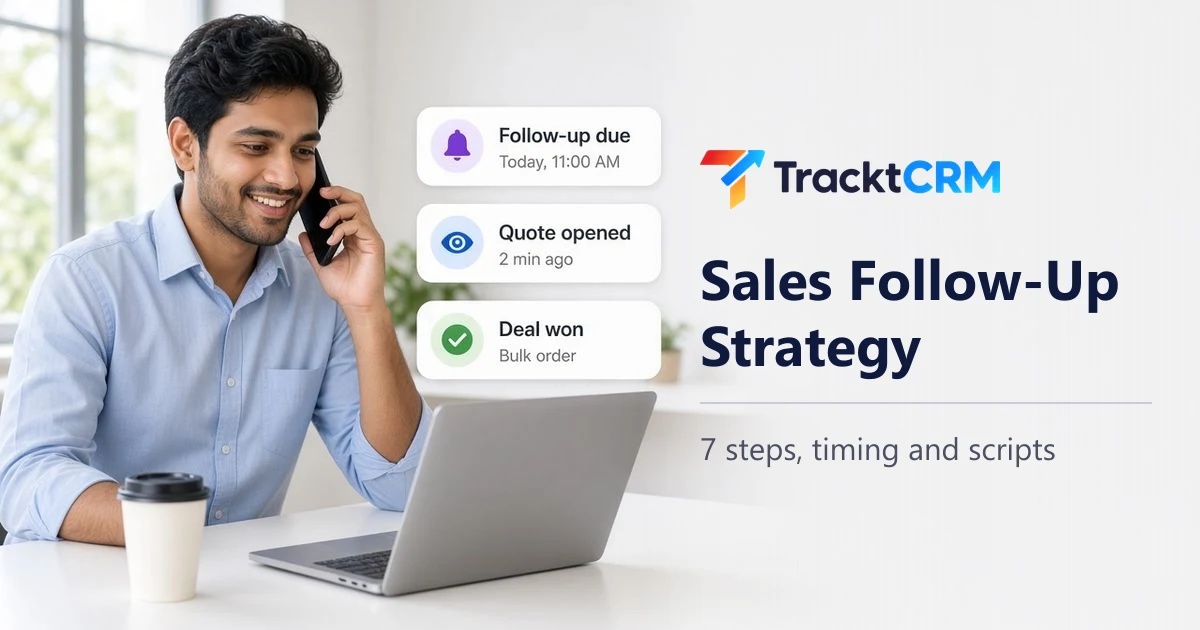
A sales follow-up strategy is the plan your team uses to move a lead from first enquiry to a clear yes or no. It decides how fast you reply, how many times you follow up, what each message says, which channel you use and when you stop.
Most deals are not lost to a competitor. They are lost to silence: a missed call nobody returned, a quote sent with no next step, a WhatsApp chat that scrolled out of sight. This guide gives you a 7-step follow-up strategy, a timing table for hot, warm and cold leads, scripts for call, WhatsApp and email, and the numbers to watch each week.
Why Sales Follow-Up Decides Who Wins the Deal
Buyers in India rarely decide on the first call. They compare two or three vendors, check with a partner or family member, wait for budget approval or simply get busy. The seller who stays helpfully in touch through that delay usually wins.
Speed matters most at the start. In a study published in Harvard Business Review, researchers looked at 1.25 million leads across 42 companies. Firms that contacted a lead within an hour were nearly seven times as likely to qualify it as firms that waited even one hour longer, and more than 60 times as likely as firms that waited 24 hours or more.
You may also have seen the line "80% of sales need five follow-ups". It is shared widely, but we could not trace it to a published study, so we do not rely on it here. The HBR finding is enough: the first reply and the next few touches are where deals are won or lost.
Why Most Sales Follow-Ups Fail
Before fixing the process, it helps to know where it usually breaks:
- No next step. The call ends with "let me know", and nobody owns what happens next.
- Empty messages. "Just checking in" gives the buyer nothing to reply to.
- Wrong channel. Long emails to someone who only answers WhatsApp, or WhatsApp spam to a corporate buyer who wants email.
- Memory instead of a system. Follow-ups live in a notebook, a phone's call log or the rep's head.
- Giving up too early, or never stopping. One message and done, or ten messages that annoy.
- No owner. Shared leads sit untouched because everyone assumes someone else called.
The 7-Step Sales Follow-Up Strategy
1. Reply to every new lead within the hour
Set a response target and measure it. For inbound leads from ads, forms, IndiaMART or WhatsApp, aim for a first touch in under 15 minutes during working hours. If a call is not possible, send a short WhatsApp or email immediately so the buyer knows a real person is on it, then call.
Assign every lead to an owner the moment it arrives. Round-robin assignment stops leads from waiting while the team decides who takes them.
2. End every conversation with a dated next step
The single most useful follow-up habit: before you hang up or leave a meeting, agree on what happens next and when. Then put it in your CRM or calendar while you are still on the call.
"I'll send the revised quote by 4 pm today. Can I call you on Thursday at 11 to go through it?"
If the buyer gives a date ("call me after Diwali", "we decide at the month-end meeting"), that date overrides your normal cadence. Follow up the day after, not before.
3. Give every follow-up a purpose
Each touch should either add value or make a decision easier. Keep a list of reasons to get back in touch:
- The answer to a question they asked on the last call.
- A short example of a similar customer, ideally in the same city or industry.
- A cheaper option, a payment plan or a smaller first order.
- A real deadline: price change, stock arriving, batch starting, slot filling.
- A summary of what you agreed, with one question to confirm.
- A yes or no question that takes five seconds to answer.
4. Mix call, WhatsApp and email
Each channel does a different job. Use them together rather than repeating the same message three times.
| Channel | Best for | Keep it |
|---|---|---|
| Phone call | First contact, objections, negotiation, closing | Short, with a clear question |
| Quick confirmations, brochures, location pins, reminders | One or two lines, friendly | |
| Quotes, proposals, comparisons, anything that needs forwarding | Specific subject line, one ask | |
| In person or video | High-value deals, site visits, demos | Booked with a time and agenda |
A pattern that works for many Indian businesses: call first, send a WhatsApp summary after the call, and email the formal quote. If a call is missed, follow it within minutes with a WhatsApp message.
One rule to plan around if you use the official WhatsApp Business Platform: you can send free-form replies for 24 hours after the customer's last message. After that window closes, only pre-approved template messages can be sent. Our guide to WhatsApp follow-up messages covers both kinds.
5. Follow a cadence, not your mood
Decide your default gaps in advance so follow-ups do not depend on how busy the rep feels that day. The next section has a full timing table.
6. Know when to stop
Following up forever wastes time and damages your brand. After a clear no, thank the buyer and ask what tipped the decision. After about six unanswered touches, send a closing message that leaves the door open, then record the reason in your CRM.
"Hi Ramesh, I haven't heard back so I'll assume the timing isn't right. I'll close this for now. If anything changes, reply here and I'll pick it up straight away."
Closing messages often get the reply that five reminders did not, because they give the buyer an easy way to say "not now" or "actually, let's talk".
7. Nurture the "not yet" leads
A buyer who is not ready this month may be ready next quarter. Separate "not interested" from "not ready yet". Move the second group to a slower rhythm: one useful message a month, a festive offer, a new product, a case study. Set a reminder for the date they mentioned so the follow-up actually happens.
Sales Follow-Up Cadence: How Often and How Many Times
Use this as a starting point and adjust for your deal size and buying cycle. Higher-value deals usually need more touches over a longer period.
| Day | Hot lead (asked for price or visit) | Warm lead (enquired, no urgency) | Cold or old lead |
|---|---|---|---|
| Day 0 | Call within 15 minutes, WhatsApp summary | Call within the hour, WhatsApp intro | Short WhatsApp or email with one useful idea |
| Day 1 | Send quote or confirm visit | Email details or brochure | |
| Day 2 | Call to discuss quote | Call with an answer or example | |
| Day 4 | WhatsApp with a customer example | WhatsApp with a question | |
| Day 7 | Call with an option or deadline | Call or email with a new reason | Second message with an offer or update |
| Day 14 | Closing message if silent | Email with a case study | |
| Day 21 | Move to nurture | Closing message if silent | Third message, then monthly nurture |
Two rules sit on top of the table. First, if the buyer gives you a date, use it. Second, a reply resets the clock: once they respond, follow the conversation, not the schedule.
What to Say Instead of "Just Checking In"
Swap empty follow-ups for messages that give the buyer something to respond to.
| Instead of | Try |
|---|---|
| "Any update?" | "Did the quote cover the 200-unit option you mentioned, or should I add it?" |
| "Just checking in." | "One of our clients in Pune had the same delivery concern. Here's how we handled it in two lines." |
| "Did you get a chance to look?" | "Quick one: is price or timing the bigger question right now?" |
| "Following up on my last email." | "Prices on this model change on the 1st. Shall I hold the current rate for you until Friday?" |
| "Please let me know." | "Would Tuesday 11 am or Wednesday 4 pm work for a 10-minute call?" |
Sales Follow-Up Scripts for Common Situations
Replace the words in square brackets and keep the tone conversational. For 20 polite email reminders with subject lines, see our gentle reminder email templates.
After a missed call
WhatsApp: Hi [Name], this is [Your name] from [Company]. I just tried calling about your enquiry for [product]. When is a good time for a quick 5-minute call today?
After sharing the price or quote
Call opener: "Hi [Name], I sent the quote yesterday. I wanted to check two things: does it match the quantity you need, and is there anything in it you'd like me to explain?"
WhatsApp: Hi [Name], sharing the quote for [product] again here so it's easy to find. Happy to adjust quantity or delivery dates if that helps.
After a demo, meeting or site visit
Email subject: Next steps after today's [demo / visit]
Email: Hi [Name], thanks for your time today. As discussed: [point 1], [point 2]. Next step is [action] by [date]. I'll call you on [day] at [time] to confirm. If anything changes before then, just reply here.
"I'll think about it"
Call: "Of course. So I can help you decide, what's the one thing you'd want to be sure about before going ahead?" Then agree on a date: "Shall I call you on Friday once you've had time?"
"It's too expensive"
Call: "Understood. Is it the total amount or the upfront payment that's the issue?" Then offer one option: a smaller first order, a different model, or a payment plan. Avoid discounting on the first objection.
"We're talking to other vendors"
WhatsApp: Makes sense to compare. If it helps, I can send a one-page comparison of what's included with us, so it's easier to check side by side.
Closing the loop after no reply
WhatsApp or email: Hi [Name], I haven't heard back, so I'll assume now isn't the right time and close this for now. If you'd like to restart, just reply here. Wishing you the best with [their project].
Sales Follow-Up Metrics to Track
You cannot improve follow-up you do not measure. Review these every week, by rep and by lead source.
| Metric | How to calculate | What it tells you |
|---|---|---|
| First response time | Time from lead created to first call or message | Whether speed is costing you leads |
| Leads never contacted | New leads with no activity after 24 hours | Gaps in assignment or ownership |
| Overdue follow-ups | Follow-up tasks past their due time | Whether reps are keeping promises |
| Touches before reply | Average follow-ups sent before the lead responds | Whether your cadence is too short or too long |
| Stage conversion | Leads moving from one stage to the next, divided by leads in the stage | Where deals stall |
| Lost reasons | Count of lost deals by reason | Whether follow-up, price or fit is the real issue |
If "leads never contacted" is above zero, fix that before anything else. It is lost money with no effort required to recover it.
A Daily Follow-Up Routine for Sales Reps
A follow-up strategy only works if it becomes a habit. A simple daily rhythm:
- Start of day (15 minutes): open today's follow-up list and overdue tasks. Call hot leads first.
- Every hour: check new leads and reply within 15 minutes.
- After every call: log the outcome, set the next follow-up with a date and send the WhatsApp summary.
- Late afternoon: clear the remaining follow-ups. Reschedule anything you cannot finish, with a reason.
- End of day (5 minutes): make sure every open lead has a next step. No next step means the lead is at risk.
Managers can run a 15-minute weekly review: overdue follow-ups by rep, leads with no activity in a week, and the top three lost reasons.
How to Automate Sales Follow-Ups in a CRM
A spreadsheet can list leads, but it will not remind anyone. A CRM turns your follow-up strategy into rules that run every day, even when the team is busy.
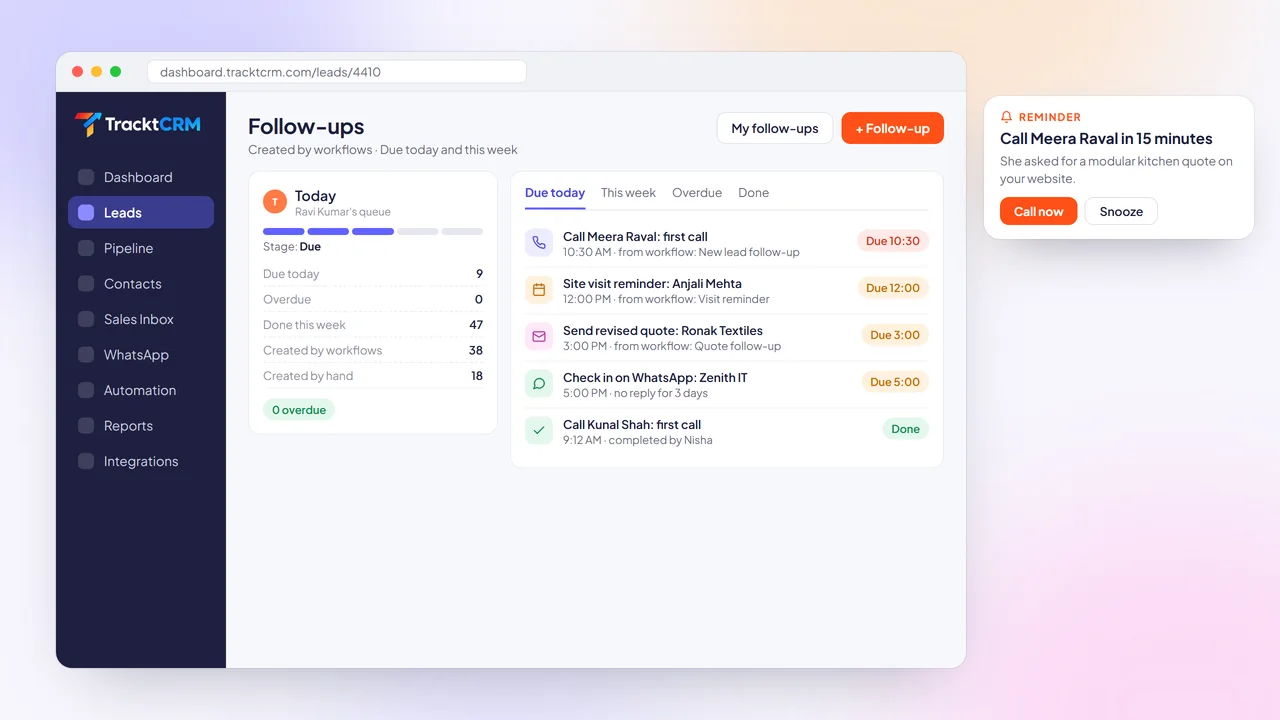
Here is how the strategy above maps to automations in TracktCRM's sales automation:
- New lead arrives: assign an owner by round robin and create a "call within 15 minutes" follow-up.
- Stage changes to Quote sent: wait two days, then create a follow-up task or, on Pro and above, send an approved WhatsApp template.
- No activity for X days: notify the owner, so quiet deals get attention before they go cold.
- Follow-up due: remind the rep at the right time instead of relying on memory.
- Email opened: create a task to call while the quote is fresh in the buyer's mind.
- Rotting deals: set how many days a deal can sit in each pipeline stage before it is flagged as idle.
Each lead keeps its calls, WhatsApp chats, emails and notes in one timeline, so whoever picks it up next knows exactly what was said. With Gmail sync and email tracking you can schedule emails, use templates with merge fields and see when a quote is opened.
The Free plan includes 3 automations, which is enough for the new lead, no activity and follow-up due rules. Pro includes 30. Sending WhatsApp templates needs the official WhatsApp Business API, available on Pro and above. Plan limits checked on 3 November 2026. See the pricing page for current limits.
Common Sales Follow-Up Mistakes to Avoid
- Pitching again in every message. Repeat the value only when you have something new to add.
- Sending five WhatsApp messages in a row. One clear message is better than a stream.
- Following up at odd hours. Stick to business hours unless the buyer chose the time.
- Ignoring the buyer's timeline. If they said "after the 15th", do not call on the 10th.
- Not recording why deals are lost. Without lost reasons you cannot tell if the problem is follow-up, price or fit.
- Discounting to get a reply. Price cuts in a follow-up train buyers to wait you out.
Frequently Asked Questions
What is a sales follow-up strategy?
A sales follow-up strategy is a planned sequence of calls, WhatsApp messages and emails that moves a lead from first enquiry to a decision. It sets how fast you reply, how often you follow up, what each message says, which channel you use and when you stop.
How many times should you follow up with a lead?
For an active lead, plan 5 to 7 touches over two to three weeks, spread across call, WhatsApp and email. Stop sooner if the lead says no, and move silent leads to a slower monthly follow-up instead of chasing them every few days.
How soon should you follow up with a new lead?
Within the hour, and within minutes if you can. A Harvard Business Review study of 1.25 million leads found that firms contacting leads within an hour were nearly seven times as likely to qualify them as firms that waited even one hour longer.
What is the best time gap between follow-ups?
A common pattern is same day, then day 2, day 4, day 7, day 14 and day 21 for a warm lead. Hot leads need tighter gaps, cold leads wider ones. If the prospect gives you a date, follow their timeline instead of your default cadence.
What should I say instead of "just checking in"?
Give the prospect a reason to reply. Share an answer to a question they asked, a relevant customer example, a price option, a deadline or a simple yes or no question. Every follow-up should add something or make a decision easier.
When should I stop following up with a prospect?
Stop active follow-up after a clear no, or after about six unanswered touches. Send a short closing message that leaves the door open, record the reason and move the lead to a monthly or quarterly nurture list.
Can a CRM automate sales follow-ups?
Yes. A CRM can create a follow-up task when a lead arrives, remind the owner when a deal goes quiet and send WhatsApp templates or emails after a set delay. TracktCRM includes 3 automations on its Free plan and 30 on Pro.
Sources
Sources checked on . Plans and prices change, so confirm current details on these links before you buy.