Most clinics and hospitals in India do not lose patients because of their doctors. They lose them in the gap between the enquiry and the appointment. A patient calls while the receptionist is busy, sends a WhatsApp message at 9 pm, books through Practo or clicks a Google ad, and nobody replies for hours. By then they have booked somewhere else.
Good hospital marketing fixes both halves of this problem. It helps the right people find you, and it makes sure every person who reaches out gets a quick reply and a proper follow-up. This guide gives you 15 practical ways to do both, written for clinic owners, doctors and hospital administrators. Every idea works for a single-doctor clinic as well as a multi-specialty hospital, and none of them needs a large budget.
What Is Hospital Marketing?
Hospital marketing is the work of helping people find your hospital or clinic, choose it, and come back when they need care again. Good hospital marketing is much more than advertising. For most providers it has three parts:
- Visibility: being found on Google Search, Google Maps, Practo and social media.
- Conversion: turning an enquiry into a booked appointment through fast replies and a helpful front desk.
- Retention: reminders, follow-ups and recall visits that keep patients coming back.
Most hospital marketing strategies focus only on visibility. The ideas below cover all three parts, because an enquiry you paid for is wasted if nobody answers it.
One rule applies throughout. Doctors in India must follow the National Medical Commission's rules on advertising and self-promotion, so check the current guidance and your state medical council before you run any hospital marketing campaign or promotion.
15 Hospital Marketing Ideas That Bring In More Patients
The ideas are grouped into five parts. Start with Part 1 even if you skip everything else. There is little point spending more on hospital marketing if the enquiries you already get are not answered.
Part 1: Answer and Track Every Patient Enquiry
Fast, consistent replies are the cheapest hospital marketing you can do. These three ideas make sure no enquiry slips through.
1. Reply to every enquiry within minutes
What to do: Aim to send a first reply within 5 to 10 minutes during working hours, on every channel.
How to do it: Decide who owns new enquiries at each time of day, for example the receptionist in the morning and the clinic coordinator in the evening. Keep the WhatsApp Business app open at the front desk with saved quick replies for the questions you hear most: timings, doctor availability, consultation fee and directions. Outside working hours, set an away message that says exactly when you will reply.
Example: If your clinic gets 20 enquiries a day and 5 of them wait until the next morning, those 5 people have a whole evening to book with another clinic.
2. Put every enquiry in one list, tagged by source
What to do: Keep calls, WhatsApp chats, Practo bookings, website forms, Google and Facebook ad leads and walk-ins in one list. Each entry needs a name, phone number, what they asked for, the source, an owner and the next step. This is front-office patient management, not clinical records.
How to do it: Start with a shared sheet if you must, or use a CRM once enquiries grow. Fill the source column every time and ask "How did you hear about us?" on the first call. Our guide to lead management software explains how enquiry tracking works in more detail. Without one list, you cannot tell which hospital marketing channel is working.
Example: A patient who messages on WhatsApp after seeing your Google profile should be logged as "Google Business Profile", not just "WhatsApp". Otherwise you will never know which channel really brought them.
3. Give your front desk a simple script
What to do: Write a short script for calls and chats, so every enquiry is handled the same way, whoever answers.
How to do it: Keep it to five steps: greet and give your name, ask the patient's name and need, offer two specific slots, confirm on WhatsApp, and note the source. Train staff never to give medical advice on the phone or in chat. Clinical questions go to the doctor.
Example script:
"Good morning, this is Priya from the clinic. May I know your name? Which doctor or service are you looking for? Our orthopaedic doctor is available tomorrow at 11:00 or 5:30. Which suits you better? I'll send the confirmation and our location on WhatsApp now. How did you hear about us?"
Part 2: Get Found on Google, Maps and Practo
For local patients, hospital marketing starts with search. These four ideas help nearby patients find you and trust you.
4. Complete your Google Business Profile
What to do: Most local patients search "dentist near me" or "child specialist in [area]" and pick from the map results. Google says local results are mainly based on relevance, distance and prominence, and a complete profile helps with relevance. For most clinics, it is the most valuable free hospital marketing tool available. See Google's tips to improve your local ranking.
How to do it: Verify your profile and choose the most accurate category, such as "Dental clinic" or "Hospital". Add your full hours, including Sunday and holiday hours, and a phone number that someone actually answers. Upload photos of the entrance, reception and waiting area, without patients in them unless they have agreed. List your services, and publish a short update every week.
Example: A weekly post about Sunday OPD timings or a new physiotherapy service keeps your profile fresh and answers a question patients would otherwise call about.
5. Ask for genuine Google reviews, the right way
What to do: Reviews help patients choose, and Google counts them as part of prominence. Ask every satisfied patient, not just a few.
How to do it: Create a review link or QR code from your Business Profile and send it on WhatsApp after the visit with a thank-you note. Reply to every review politely. Never confirm in a reply that someone is your patient or mention any health detail. Google does not allow incentives such as discounts in exchange for reviews, so read Google's tips to get more reviews and never write reviews yourself.
Example message: "Thank you for visiting us today. If you were happy with your visit, a short Google review helps other families find us: [review link]."
6. Keep your Practo and directory profiles complete
What to do: Many patients compare doctors on Practo, Justdial and similar directories before they call. Old or inconsistent details cost you trust and bookings.
How to do it: Use the same clinic name, address, phone number and timings everywhere. Keep each doctor's qualifications, consultation fee and photos current. Reply to directory enquiries the same day and add them to your enquiry list, so they are followed up like any other lead.
Example: If your Practo profile still shows old timings, a patient may arrive when the clinic is closed, leave disappointed and post a poor review.
7. Get the basics of local SEO right on your website
What to do: Your website should answer the questions patients ask before they book: who the doctors are, what you treat, where you are and when you are open. It is the home base for the rest of your hospital marketing.
How to do it: Create one page for each main service or speciality and one page for each doctor with their qualifications. Use page titles with the service and area, for example "Physiotherapy Clinic in Sector 22, Chandigarh". Add click-to-call and WhatsApp buttons, an embedded map and a short enquiry form, and check that every page loads quickly on a mobile phone.
Example: A patient searching "knee physiotherapy near Sector 22" is far more likely to find a page about knee physiotherapy at your Sector 22 clinic than a general home page.
Part 3: Bring Patients In With Digital Marketing for Hospitals
Digital channels add reach to your hospital marketing, but they work best once the basics in Parts 1 and 2 are in place.
8. Use WhatsApp for communication, not just replies
What to do: Patients in India reply on WhatsApp faster than on email or SMS. Use it across the whole patient journey, with their permission.
How to do it: Set up a business profile in the WhatsApp Business app with your address, hours and a list of services. Use labels such as "New enquiry", "Booked" and "Follow-up due". Send a location pin and practical instructions with every confirmation, for example "please bring your previous reports". Avoid bulk promotional messages that patients did not ask for. When several staff share one number, a WhatsApp CRM tool keeps each chat with the right person.
Example: "Your appointment with the dentist is confirmed for Tuesday at 11:00. Here is our location. Reply 1 to confirm or 2 to reschedule."
9. Publish patient education content
What to do: Answer the common questions your doctors hear every day in short, simple posts and videos. This is the most useful form of social media marketing for hospitals, because it builds trust before the first visit. Done well, it is hospital marketing that patients actually welcome.
How to do it: Make a list of 10 questions patients often ask before booking, such as what happens at a first visit or what to bring for a test. Have a doctor review every piece. Keep it to general awareness, with no cure claims and no before-and-after promises. Post on Instagram, Facebook, YouTube Shorts and your website, in the languages your patients speak.
Example: A two-minute video of your physiotherapist explaining what happens in a first session answers the main worries a new patient has before they call.
10. Run small, targeted ads for specific services
What to do: Use Google Search ads for "service + area" searches and Facebook or Instagram lead forms for services people plan in advance, such as health check packages. Ads are the fastest hospital marketing channel to switch on, and the easiest to waste money on.
How to do it: Start with one service, a small radius around your clinic and a fixed daily budget. Send every ad lead to your enquiry list immediately, because ad money is wasted if leads wait until tomorrow. Follow the advertising rules for doctors mentioned above.
Example: Run one campaign for two weeks, then compare the cost per booked appointment, not the cost per click, before you decide whether to continue.
11. Run health camps and build local relationships
What to do: Health camps and talks at housing societies, offices and schools put your doctors in front of local families, and good relationships with nearby chemists, labs and gyms keep your name in front of people.
How to do it: Partner with a resident welfare association or a company HR team, and collect contact details only with clear consent. Follow up within two days with your timings and a simple way to book. Keep local partners updated on your doctors and services, but never pay or accept commissions for patient referrals, which India's medical ethics rules do not allow.
Example: After a Sunday camp at a housing society, a WhatsApp message on Monday with your timings and location turns interested residents into booked appointments.
Part 4: Keep Patients Coming Back
Retention is the most overlooked part of hospital marketing. A patient who had a good experience is the easiest patient to bring back.
12. Send appointment reminders
What to do: Remind every patient the day before and on the morning of their appointment.
How to do it: Include the date, time, doctor, address, what to bring and an easy way to reschedule. A patient who can reschedule in one reply is less likely to simply not turn up, and the slot can be offered to someone else.
Example: "Reminder: your appointment is tomorrow, Tuesday, at 11:00 with the dentist. Please bring your previous X-rays. Reply 2 if you need a different time."
13. Set up a patient follow up routine
What to do: Patient follow up after each visit shows that you care and brings people back for the review visits their doctor advised. Keep it non-clinical: a thank-you, a check that they have the next appointment date, and an easy way to ask a question.
How to do it: Agree on a simple schedule. For example, send a thank-you and review link on day 1 and a reminder a few days before any review visit the doctor advised. For hospitals, follow up with patients after discharge to confirm their follow-up appointment date and share the right contact number. Any clinical question goes straight to the doctor or nurse.
Example: A physiotherapy clinic that messages each new patient before their second session finds out early who is unsure, and can answer their question before they drop out.
14. Run recall and retention reminders
What to do: Many patients are advised by their doctor to return at a set interval, such as a six-monthly dental check-up. Keep a list of those due dates and remind patients before they are due.
How to do it: Record the advised next visit date when the patient leaves. Each week, message the patients who are due in the next 7 to 10 days. Always let people opt out of reminders, and only remind them about visits their own doctor advised.
Example: If 40 patients were advised a six-month dental check-up in April, a reminder in early October gives each of them a reason to book with you rather than search again.
Part 5: Measure What Works
15. Track which source brings booked patients
What to do: Once a month, look at enquiries, booked appointments and visits by source, and at how fast your team replied. This is how hospital marketing stops being guesswork.
How to do it: Use the source column from idea 2. Count enquiries and visits for each source, and compare them with what you spent. A sales dashboard shows these numbers without building a report by hand.
Example: Suppose your Google Business Profile brought 60 enquiries and 30 visits in a month, while ads brought 80 enquiries and 12 visits. The profile deserves more of your time, and the ads need better targeting or faster follow-up.
How a CRM Helps Clinics Get More Patients
Most hospital marketing ideas in this guide depend on one thing: knowing who enquired, from where, and what happens next. A register, a diary and several staff phones cannot do that reliably once enquiries grow. That is the job of a CRM (customer relationship management) system. It manages enquiries, appointments and follow-ups. It is not a clinical record or billing system.
Here is how TracktCRM helps clinics and hospitals:
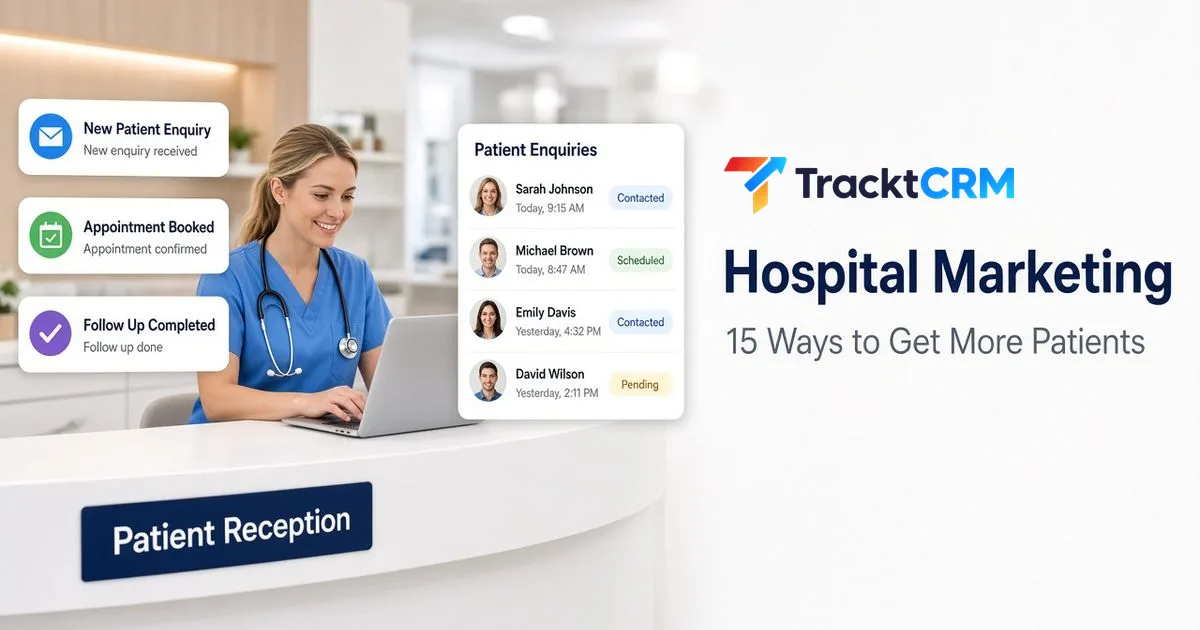
- One list for every enquiry. Enquiries from your website, Google and Facebook ads, Practo and WhatsApp land in one list with their source attached.
- An owner for every patient. Each enquiry is assigned to a staff member, so no one is answered twice or not at all.
- Follow-up and appointment reminders. Staff are reminded when a call-back, an appointment or a review visit is due.
- Full history in one place. Calls, WhatsApp chats and notes stay on each record, so anyone at the desk can pick up where a colleague left off.
- Source reports. See which channels bring enquiries and booked appointments, which makes idea 15 a five-minute job.
See how this works on our healthcare CRM software page, and how WhatsApp chats are saved on each record with WhatsApp CRM. If you are comparing free options first, our guide to the best free CRM for small business explains what free plans include and where their limits are.
A 7-Day Hospital Marketing Action Plan
You do not need to do all 15 ideas at once. This hospital marketing plan gets the foundations in place in one week.
| Day | Task |
|---|---|
| Day 1 | List every channel where enquiries arrive (calls, WhatsApp, Practo, website, ads, walk-ins) and who answers each one. |
| Day 2 | Update your Google Business Profile: category, hours, phone, photos, services and a first weekly post. |
| Day 3 | Check your Practo and directory profiles and make the name, address, phone and timings match everywhere. |
| Day 4 | Write the front-desk script, WhatsApp quick replies and an away message for after hours. |
| Day 5 | Set up one enquiry list with source, owner and next step, and start logging every enquiry. |
| Day 6 | Write your reminder, follow-up and review-request messages, and create your Google review link or QR code. |
| Day 7 | Review the week: enquiries by source, reply times and bookings. Pick the next hospital marketing idea from this guide. |
Start With the Enquiries You Already Get
The quickest win in hospital marketing is rarely a new campaign. It is answering every enquiry you already receive, quickly and politely, and following up until the patient books. Get found on Google and Practo, make it easy to reach you on WhatsApp, remind patients about their visits and measure which sources work. Then put more of your hospital marketing effort into those sources.
When enquiries outgrow a register and a few phones, a CRM built for clinics and hospitals keeps every patient enquiry, reminder and conversation in one place.
Frequently Asked Questions
What is hospital marketing?
Hospital marketing is everything a hospital or clinic does to help people find it, choose it and come back. It covers your Google Business Profile, reviews, website, Practo listing, WhatsApp communication, health camps and ads, plus the front-desk work of answering and following up every enquiry.
How do you market a hospital in India?
Start with the basics: a complete Google Business Profile, steady genuine reviews, an updated Practo profile and a simple website with timings and doctors. Then answer every enquiry fast, follow up on WhatsApp and track which source brings patients. Check National Medical Commission rules before you run any promotion.
How can I improve hospital marketing on a small budget?
Fix the leaks before you spend more. Reply to every call and WhatsApp message within minutes, send appointment reminders and follow up after visits. Ask satisfied patients for honest Google reviews and keep your listings accurate. These steps cost little and often bring in more patients than a new ad campaign.
How do you do digital marketing for hospitals?
Pick the channels your patients already use, usually Google Search, Google Maps and WhatsApp. Publish helpful awareness content, run small location-targeted ads for specific services and send every enquiry to one list. Each month, check which source led to booked appointments and move your budget to what works.
How do hospitals market themselves?
Most hospitals combine local search visibility, reviews, doctor profiles, health camps, corporate tie-ups and patient education on social media. The ones that grow steadily also run a disciplined front desk: every enquiry is answered quickly, logged with its source and followed up until the patient books or says no.
Can a CRM help with hospital marketing?
Yes. A CRM does not replace marketing, but it makes sure the enquiries your marketing brings in are not lost. It collects enquiries from every source in one list, gives each an owner, reminds staff to follow up and shows which channels bring patients. It is not a clinical or billing system.